Cognitive Rehabilitation Tool Kit after Brain Injury

Cognitive Rehabilitation Tool Kit after Brain Injury

Anne Brannagan, DIPCOT, MSc., Roberta DePompei, Ph.D., Kit Malia, BED, MPhil, CPCRT, Barbara A. Messenger, M.Ed., McKay Moore Sohlberg, Ph.D.
Tool Kit on Cognitive Rehabilitation after Brain Injury has 6 treatment manuals and 30 tip cards on acquired and traumatic brain injuries in adults and veterans for use by therapists and caregivers in rehabilitation and community programs.
Item: COGTK
Price: $284.00 Market price: $384.00 save 26%
Quantity Add to wish list
26%

Full Description

Clinicians and therapists will find this Cognitive Rehabilitation Tool Kit contains practical tools and programs for assessing and treating executive changes after acquired brain injuries in adolescents and adults. They are designed for use in inpatient, rehabilitation, veterans programs, community and home settings. The kit also includes educational materials for families and caregivers.

This inclusive kit provides the foundation for a cognitive rehabilitation program that focuses on helping individuals maximize their abilities with hands on tools that are based on clinical experience and best practices. This comprehensive kit includes...

  • Hero’s Journey
  • Procedure for Assessing Awareness and Adjustment Following Brain Injury
  • How to do Cognitive Rehabilitation Therapy Parts 1 and 2
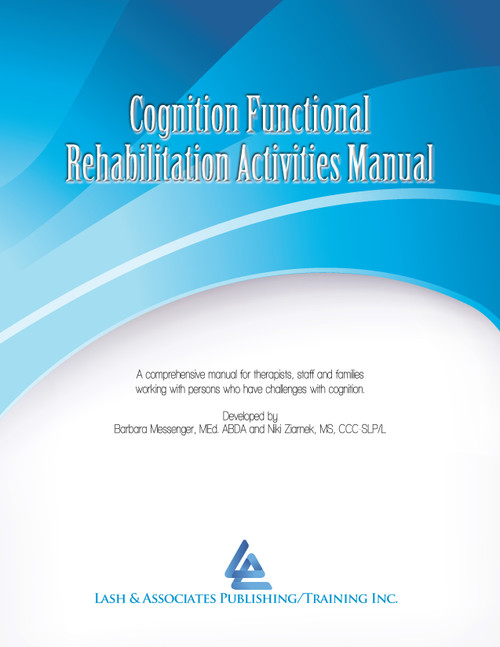
  • Cognitive Functional Rehabilitation Manual
  • Cognitive Communication: Functional Activities Manual
  • Memory after Brain Injury (10 tip cards)
  • Changes in Self Awareness after Brain Injury (10 tip cards)
  • Communicating with an Adult after Brain Injury (10 tip cards)
Details
Item COGTK
Pages Full Kit includes 6 manuals and 30 tip cards.
Year Second edition, 2010

Authors

Anne Brannagan, DIPCOT, MSc.

Ms Brannagan is particularly interested in the cognitive and executive sequelae of acquired brain injury. She runs workshops with Kit Malia, training both professionals working in the field and caregivers of individuals with brain injury around the country. Ms Brannagan has developed a number of rehabilitation activities, including a practical approach to the assessment of executive problems (The Brannagan Executive Functions Assessment) following brain injury and cognitive/psychosocial groups.

Roberta DePompei, Ph.D.

She is Department Chairman, a Professor and Clinical Supervisor at the Speech and Hearing Center at the University of Akron in Ohio. She is a Vice President at Lash and Associates Publishing/Training Inc. An advocate of the needs of youths with brain injuries and their families, she is on numerous national task forces and committees. Widely published and a national and international presenter, Dr. DePompei specializes in the impact of brain injury upon speech, language and communication. She is especially interested in developing transitional opportunities for youth as they progress through school and prepare for adulthood.

Kit Malia, BED, MPhil, CPCRT

He is the only Certified Cognitive Rehabilitation Therapist in the United Kingdom (via the Society for Cognitive Rehabilitation, USA). He holds a research degree in Neuropsychology. Initially trained as a teacher for people with learning disabilities, he has spent almost 19 years working as a cognitive rehabilitation therapist with adults who have acquired neurological injuries at The Defense Medical Rehabilitation Center, one of the largest brain injury rehabilitation units in the UK.

Mr. Malia has published scientific papers on cognitive and psychosocial rehabilitation, and clinical standards in brain injury rehabilitation. He is on the Board of Directors for the Society for Cognitive Rehabilitation, USA, and is the chairperson of the International Division for the SCR.

Barbara A. Messenger, M.Ed.

As a Behavior Rehabilitation Therapist at the Center for Comprehensive Services (CCS), MENTOR Network, with survivors of traumatic brain injury, Ms Messenger is a certified disability analyst and certified rehabilitation counselor. Her experience includes individual, group and marital counseling as well as vocational rehabilitation counseling and case management.

McKay Moore Sohlberg, Ph.D.

Dr. Sohlberg is a nationally recognized leader in the field of traumatic brain rehabilitation. For the past 21 years she has worked as a clinician, researcher and administrator in the development of programs to assist individuals with brain injury to reintegrate into the community at maximal levels of independence. The types of intervention programs that she has developed and about which she has conducted research have become model programs adopted by rehabilitation centers throughout the United States, Canada and Europe. Dr. Sohlberg received her master’s degree in Speech and Hearing Sciences and her PhD in Educational Psychology at the University of Washington. She is currently professor in the Communication Disorders Program at the University of Oregon. She conducts clinical research aimed at developing and evaluating methods to help adolescents and adults manage cognitive changes after brain injury.

Contents

The Cognitive Rehabilitation Tool Kit includes 6 treatment manuals and 30 tip cards (10 each of 3 titles).

Hero's Journey

Taking a unique approach to understanding the complexity and impact of acquired brain injuries, Kit Malia and Anne Brannagan have produced a workbook that is filled with practical exercises for clinicians, families, and individuals to use in rehabilitation settings, community programs and at home. The activities are designed as “adventures, challenges and insights” that are intended to enhance understanding of how the brain works and the various consequences of an injury. Each exercise has clear instructions and is accompanied by witty and clever analogies and illustrations which make this workbook entertaining as well as educational.

It is divided into 5 parts with activities focusing on understanding:

  • The brain
  • Rehabilitation
  • Cognition
  • Emotions and Behavior, and
  • Adjustment

This workbook is an innovative approach to brain injury education that is a “must have” for any brain injury program.

How to do Cognitive Rehabilitation Therapy: A Guide for All of Us

These two manuals take a practical hands on “How to” approach to cognitive rehabilitation therapy (CRT). They have been written specifically for therapists and families working with and living with persons with brain injury and have an easily readable format with user-friendly text.

Part 1 explains the theoretical underpinnings for how to do CRT.

  • The Introduction discusses "What is cognitive rehabilitation therapy?" and "Why treat cognitive problems?"
  • Section on Principles describes how the brain works and the importance of structure and practice. Metacognition is discussed along with insight and awareness. The interaction between cognition, emotions and behavior is described. Examples of the therapeutic milieu and goal setting are given.
  • Section on Assessment and Treatment covers how to conduct an assessment and gives detailed treatment approaches for education, process training, strategy training and functional activities training.
  • The Evaluation section identifies issues to consider, examines the efficacy of CRT and shows how to measure outcomes.

Part 2 describes how to make the theory work with plenty of case examples. Five detailed cognitive treatment modules are presented on attention, visual processing, information processing, memory, and executive function. The final section explains how to CRT in different settings with various diagnostic groups.

These manuals can be used in schools, home, rehabilitation programs, and community agencies. They provide…

  • practical information on cognitive rehabilitation therapy for individuals with brain injury, their caregivers and staff working with them
  • translation of research findings into tools and strategies for everyday practice

Cognitive Communication Rehabilitation Activity Manual

This new manual is created for persons who wish to enhance their cognitive communicative skills. It provides many problem solving cognitive-language based activities. This manual develops moderate language levels that allow individuals to expand basic cognitive communication skills to more complex levels. It provides three basic segments.

The first segment helps increase word finding skills. It relies on words that are used daily to communicate functional wants and needs. The user can work on these lists in a number of ways to enhance ability to complete communication with significant others in the environment.

The second segment has exercises in word comprehension. It is based on simple reading activities and categorization exercises that stimulate memory for functional reading tasks. The user can develop skills to assist in completion of interactive participation in community activities that require reading.

The final section provides additional exercises for reading at the sentence level and beyond. Many individuals enjoy looking at magazines or the web to gather information. Exercises such as these allow for testing comprehension and expanding language skills to help people function more independently in their homes and communities.

Cognition Functional Rehabilitation Activity Manual

This manual teaches a therapeutic style of interaction using a step-by-step format. Someone with little or no experience in working with persons with disabilities can pick up these manuals and immediately be able to interact in a therapeutic manner while facilitating independence.

Can be used by any caregiver including direct care staff, nurses, therapists, family, teachers, and aides. They can be used with children or adults with any type of neurological condition involving social, cognitive and behavioral challenges. Useful for inpatient and outpatient rehabilitation programs, community programs, residential settings, schools and at home.

This manual features worksheets and data forms for tracking performance and outcomes, with full instructions for administration. Each activity has a documentation form for easy inclusion in clinical records. Includes over 60 activities and documentation sheets on orientation, attention, memory, problem-solving, social interactions, comprehension, money management, reading, organization, community orientation, and health awareness.

Procedure for Assessing Awareness and Adjustment Following Brain Injury

This manual gives clinicians and caregivers a procedure with practical tools for assessing changes in awareness and adjustment in adults with brain injury. Using a methodical approach with step by step instructions, users are guided through 23 steps with 24 worksheets for assessing intellectual awareness, emergent awareness and anticipatory awareness. Once the levels of awareness and adjustment have been assessed, information is used to set short and long term goals for six domains of cognitive, executive, communication, physical, emotional and other. Accompanying the 71 page manual is a CD with PDF forms for all worksheets and score sheets.

This manual provides methods for clinicians and caregivers who are working with clients in a variety of settings including inpatient and outpatient programs, community based programs and home settings. It includes methods for including families in the assessment process by gathering and comparing their observations and experience with that of direct care staff.

Memory After Brain Injury

This tip card explains the basics of how memory works and why it may be affected by a brain injury. It will help families, individuals, clinicians and therapists understand the different types of memory by clear definitions and examples of how each type of memory is used in everyday life. A section on myths and facts about memory addresses the most common misinformation about memory.

There are tips for survivors, caregivers, therapists and families that show how to use strategies for managing memory problems at home and in the community.

Changes in Self Awareness After Brain Injury

Changes in self awareness can affect a person’s actions and relationships. This can result in difficulties for the individual as well as the family. Impaired self awareness can limit or slow recovery because individuals may not follow therapy or treatment recommendations. Efforts by family members to help can be especially frustrating if the person insists that “everything is fine” or “I don’t need help.” This tip card describes 4 major causes of altered awareness after a brain injury and provides tips and strategies for therapists and caregivers.

Communicating with an Adult after Brain Injury

Tip card explains how reading, writing, speaking, conversing or gesturing can change after a head injury. Describes effects of a brain injury on speech and changes in expressive and receptive skills. Explains why communication difficulties often appear in daily life rather than in formal tests. Gives practical tips for families on improving communication and finding help.

Send to friend

: *
: *
: *